Youth Perspectives on Climate Mobility and Justice Across the World Voices from Asia-Pacific: A Collaboration between the Pacific Island Students Fighting Climate Change (PISFCC) and MYCP
“Tell us a story about how you perceive climate mobility in your local context and what justice would look like in this case.”
From Local to Glocal: A Community-based Approach to Influencing the International Community for Resilience in Climate Mobility
“... the people of the Global South, are seen as persevering, that is because it’s the only option they have. To persist through great loss, whilst executing all solutions at their disposal for a problem they did not create.”
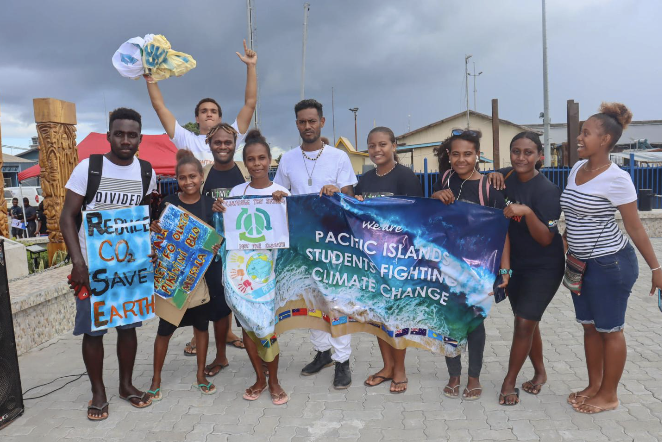
Source: United Nations Development Programme (UNDP) Pacific Office
One might have heard about the success of the International Court of Justice (ICJ) Advisory Opinion on Climate Change. Behind the success of such political momentum, there were voices that started on a grassroots level in campaigns done by 27 students from the University of South Pacific in Fiji. The campaign emerged as the youth-led organisation collaborated with other youth organisations that led to efforts being made at the Pacific Islands Forum to raise the concern on climate change at the international court. It is no other than the Pacific Islands Students Fighting Climate Change (PISFCC).
In 2021, it eventually led Vanuatu to announce that the State will champion for the advisory opinion from the ICJ by firstly engaging with Pacific nations on a shared concern. Now, the Advisory Opinion has been adopted at the United Nations General Assembly (UNGA) under Resolution A/80/L.65 with 141 votes.
Climate change induces human mobility, in which the Paris Agreement acknowledges through its preamble, “Acknowledging that climate change is a common concern of humankind, Parties should, when taking action to address climate change, respect, promote and consider their respective obligations on human rights, the rights of … migrants.” Identifying those migrating due to climate change may also come with displacement induced by sea level rise, as demonstrated in small island States and low-lying coastal States, acknowledged in Paragraph 357 of the ICJ Advisory Opinion on Climate Change.
As sea level rises cause the possibility of human displacement, one shall hear the voices from the Pacific that persist through great loss, whilst executing all solutions at their disposal for such concern. Here, we invite representatives from the PISFCC: Siosiua Veikune, PISFCC’s Vice President and Francine Elisaia, PISFCC’s Digital Media Lead, to share the stories from Tonga and Samoa on where they have pursued justice amidst mobility induced by climate change.
1. Tell us a story about how you perceive climate mobility in your local context and what
SIOSIUA: Climate mobility in Tonga is viewed similarly to how it is viewed everywhere else in the Global South. It is an unrelenting and unforgiving erasure of identity, and though the people of Tonga, the people of the Pacific, the people of the Global South, are seen as persevering, that is because it’s the only option they have. To persist through great loss, whilst executing all solutions at their disposal for a problem they did not create. Justice for those affected by climate mobility therefore has multiple faces. Their justice can be rights-based such as the right to not to be displaced, the legal recognition of climate refugees, the right to a nationality, or even the rights of future generations rooted in intergenerational equity; and though procedurally limited, it establishes that current and future generations have the power to dictate their claims to the world they will inherit. Their justice can also be practically-based; and most powerful I believe is anticipatory justice. The idea that justice doesn't wait until displacement happens. It demands that high-emitting states take binding action today, precisely because the victims of inaction are people who are barred from decision-making spaces, or are immobilised by the weight of the climate catastrophe.
FRANCINE: While climate mobility affects the entire Pacific region, its impact on Samoa differs significantly from low-lying atoll nations such as Tuvalu, Kiribati, and the Marshall Islands. In Samoa, displacement is primarily internal and localised rather than international; communities have been observed to move within Samoa's boundaries, not overseas to other countries. An example of this occurred in 2009, when a devastating earthquake and tsunami forced entire coastal communities to move inland and rebuild their lives away from the ocean that had once provided them sustenance and income and tragically took away almost everything they had.
For Samoans, and Pacific Islanders at large, land is inherently tied to identity. Because people share deep ancestral and cultural connections to their environment, forcefully separating them from their areas strips away both their homes and their heritage. In this localised context, true justice requires establishing robust legal and social frameworks that protect vulnerable communities and safeguard their fundamental right to remain on their homelands without displacement.
However, genuine climate justice must look beyond local adaptation and address global root causes by holding major polluters accountable. Recent international milestones, such as the International Court of Justice Advisory Opinion and the follow-up United Nations General Assembly Resolution, mark critical steps toward legally binding high-emitting nations to their environmental responsibilities – a pivotal moment in climate history.
To truly restore climate justice, the global community cannot afford to be reactive and to wait until climate change has already impacted our homes. True progress requires tackling big polluters head-on while implementing mitigating and adaptive measures before climate disasters strike, rather than waiting to manage the damage afterward. While the journey ahead is complex and challenging, persistent, unwavering advocacy remains absolutely vital to preventing further loss.
2. How has community leadership enhanced advocacy on climate mobility and seeking justice by contextualizing advocacy based on local context?
SIOSIUA: Community leadership in Tonga has progressed climate mobility advocacy, in how it roots the argument in lived reality and firsthand experiences of frontline communities. Our people are not facing a future threat, because displacement is already happening; from sea level rise, irregular cyclone seasons, saltwater intrusion, the Pacific and the rest of the Global South are far too familiar with these catastrophes. However, when you root for advocacy from within the community, it carries something that external voices cannot; an understanding that land, people, and identity are inseparable, because it’s planted in a centuries-long relationship with one’s environment; the loss is more intimate. Community-led advocacy asserts our people’s right to stay, and if movement must happen, our right to move with dignity and on our own terms. This is what contextualising advocacy means.
3. How would you portray a call to action that can strengthen advocacy on climate mobility on an international scale?
SIOSIUA: By centering the voices of frontline community members; and doing so ethically, consensually, non-extractive, and with respect to their experiences and the culture in which it derives from.
FRANCINE: Echoing Siua’s sentiments, it is not optional but imperative to strengthen advocacy on climate mobility by empowering frontline communities and ensuring their voices are not only heard, but loud and from them, directly. Their stories, their lived experiences must be told by them. It is also important to shift the narrative away from ‘Pacific peoples are drowning’ or ‘Pacific peoples are merely climate refugees’— we all already know that. We need to focus now on Pacific peoples fighting to protect their homes, their livelihoods and those of their communities and future generations. There is no doubt that Pacific peoples are vulnerable to climate change, but it is important now to empower them and to also centre CTAs on Pacific resilience, Pacific rights, the Pacific fight for climate justice, and continued collaboration and unity among Pacific countries, peoples, and with the greater international community, too.
When we talk about climate mobility, one does not merely talk about mobilizing as an immediate solution. Instead, one can see that it moves beyond physical movement: the losses of homes and heritage tied in one’s cultural identities. To Siua and Francine, it is an unrelenting and unforgiving erasure of identity that climate mobility shall be regulated with adaptive measures instead upon the loss. This shall include understanding the value of land that constitutes the identities of locals that their lived experiences shall be empowered to co-create solutions, not portraying in limited narrative. At the end of the day, the community-based approach empowers locals that have always been at the frontline of adapting to climate change for pollutants they may have not emitted.