
A comprehensive collection designed to serve as a valuable resource for stakeholders engaged in youth and children migration issues.
The Repository of Practices documents effective strategies and methodologies and interventions that have been implemented across diverse contexts. By consolidating these practices, the repository aims to promote knowledge sharing and support the continuous improvement of initiatives aimed at enhancing the well-being of migrant youth and children.
Resource Type
- Advocacy Brief
- Capacity Building
- Climate
- Declaration
- Education
- Gender
- Global Compact on Migration
- Global Forum on Migration & Development
- Health
- Human Rights and Inclusion
- Human Trafficking & Labour
- Impact Report
- MYCP Written Submission
- Policy Brief
- Policy Paper
- Report
- Research
- Statement
- Youth Committee on Migration & Displacement Data
- Youth on the Move
- Youth, Peace and Security
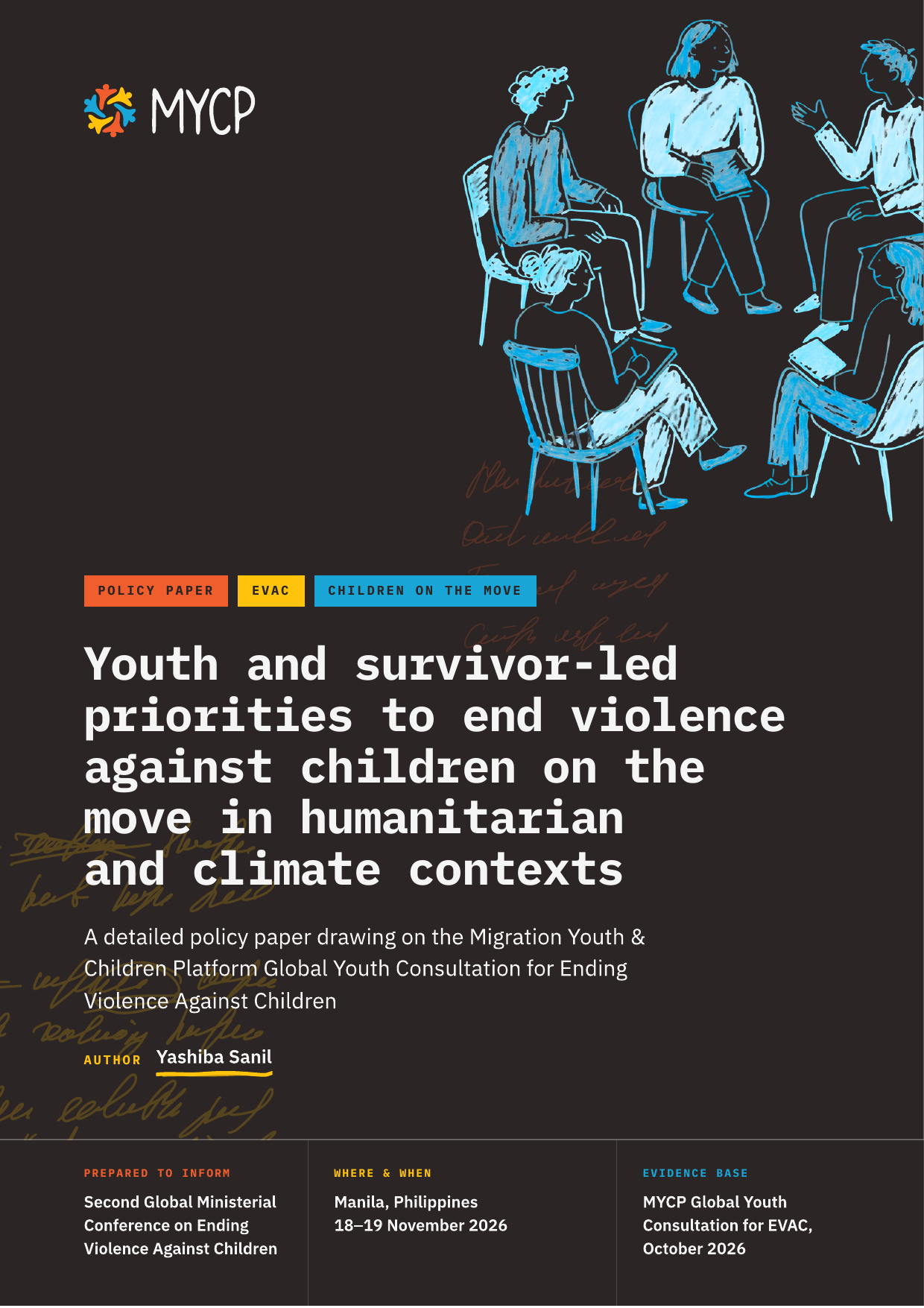
Ending violence against children on the move: youth and survivor-led priorities for the 2026 Ministerial Conference
Protection only works when a child can reach it safely, understand it, trust it and keep using it after the next move. MYCP's policy paper turns its 2026 Global Youth Consultation for Ending Violence Against Children into five priorities for the Second Global Ministerial Conference in Manila, 18–19 November 2026.

Strengthening Implementation of the Global Compact for Safe, Orderly and Regular Migration (GCM): Youth Policy Priorities for the 2026 International Migration Review Forum (IMRF)
The International Migration Review Forum (IMRF) 2026 Progress Declaration represents a critical opportunity to address these gaps and strengthen implementation of the GCM.This paper outlines MYCP’s policy priorities and general recommendations to ensure that migration governance is youth-centred, rights-based, and responsive to current global challenges. Strategic Priority: Recognition of Youth as Stakeholders

JUSTICE WITHOUT BORDERS UNDER THREAT: ENSURING ACCESS TO JUSTICE FOR MIGRANT,REFUGEE, DISPLACED WOMEN AND GIRLS AND OTHER MARGINALISED PEOPLE AT CSW70
Justice systems cannot claim universality if they exclude those whose lives cross borders. If CSW70 aims to strengthen access to justice for all, then structural barriers faced by migrant, refugee women and other marginalised individuals must be addressed explicitly. This requires legal reform, strengthened accountability, sustained investment in support services, and meaningful participation of migrant women and girls in policy development.